
I’ve always wanted to write, bringing context about what spiritism is for those unfamiliar with it or curious about the doctrine. Spiritism is an important part of my life, and I believe that through this article, I’m opening a phase in my digital life where I speak openly online about my faith :)
What is Spiritism?
Spiritism, the spiritist doctrine, or Kardecism is a spiritualist doctrine created in France in the mid-nineteenth century by professor and researcher Hippolyte Léon Denizard Rivail—known by the pseudonym Allan Kardec.
This doctrine seeks to explain, grounded in Christianity, the process that a Spirit undergoes both while alive and after death, and the evolution inherent to this process. To do so, it considers belief in reincarnation, communication with Spirits, and the existence of a spiritual world.
Beyond being spiritualist (believing in the afterlife), it interacts with philosophical and scientific concepts, seeking to understand things such as the nature of the Spirit, the laws governing the universe, and the meaning of life.
History of Spiritism
Spiritism emerged in France in 1857 when Allan Kardec published “The Spirits’ Book”; he based his work on a series of communications he received from these Spirits through mediums (briefly, people who possess the ability to exchange communication with Spirits). These communications were organized in questions and answers, forming the foundation of the spiritist doctrine.
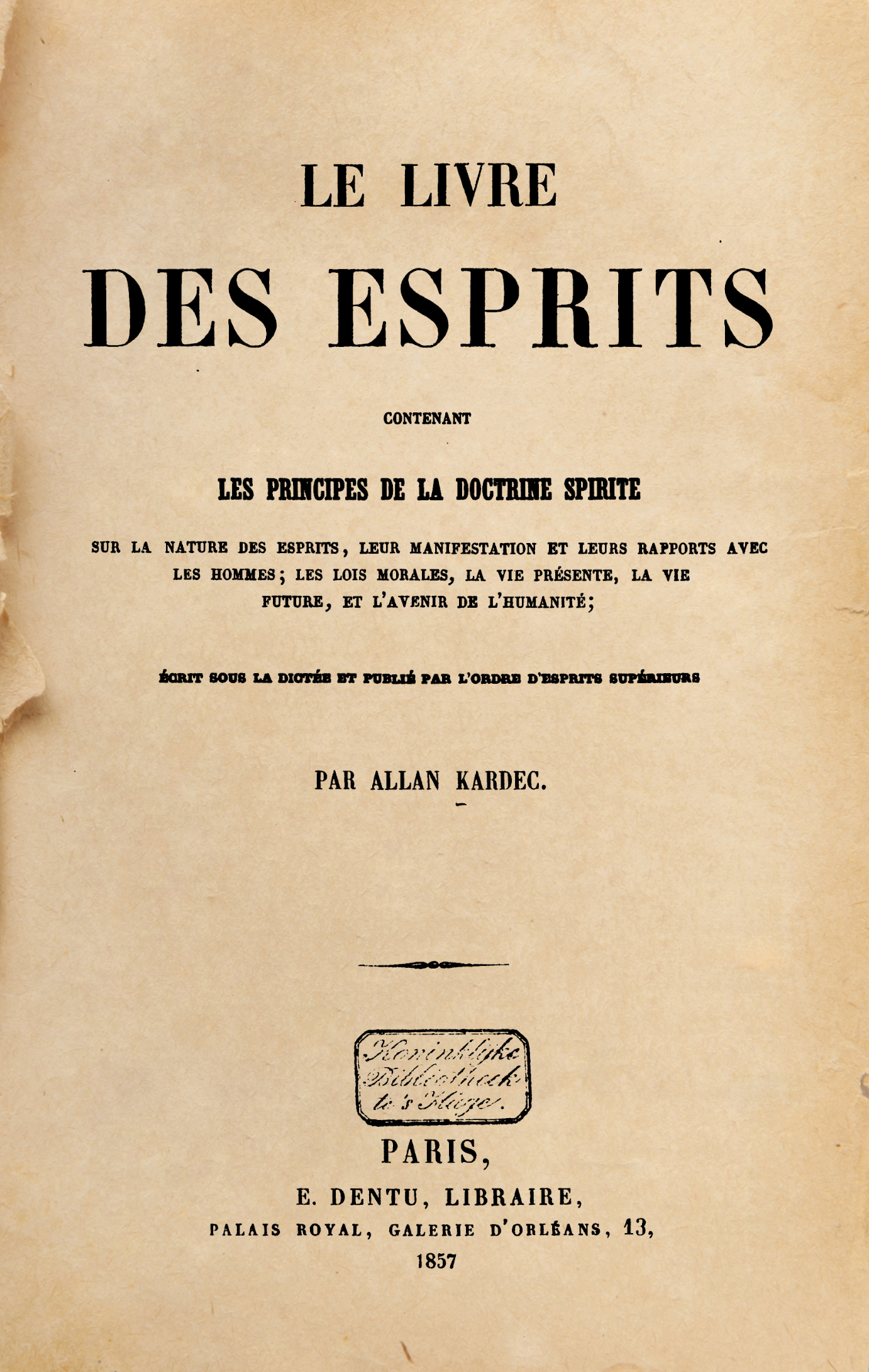
Image of the cover of The Spirits’ Book, from 1857. Source: IDEAK
After this book, Allan Kardec continued developing the doctrine, publishing other works such as “The Mediums’ Book,” “The Gospel According to Spiritism,” “Heaven and Hell,” and “The Genesis.” He also founded the Parisian Society for Spiritist Studies, which became an important center for the dissemination of spiritism.
Spiritism spread rapidly throughout Europe and later to Latin America, especially in Brazil, the country with the largest spiritist community in the world today.
Principles of Spiritism
If we could summarize what spiritism believes in, we would cover some fundamental principles, based mainly on questions and answers from The Spirits’ Book:
1. Existence of God
Spiritism believes in an eternal, immutable, immaterial, unique, just, and good God. This principle is so essential that it was the first question (and first chapter) addressed by Kardec:
- What is God?
“God is the supreme intelligence, the primary cause of all things”
Later, he questions God’s attributes:
- When we say that God is eternal, infinite, immutable, immaterial, unique, omnipotent, supremely just and good, do we have a complete idea of His attributes?
“From your point of view, yes, because you believe you encompass everything. Know, however, that there are things above the intelligence of the most intelligent man, which your language, restricted to your ideas and sensations, has no means of expressing. Reason indeed tells you that God must possess these perfections in the highest degree, for if one of them were lacking, or were not infinite, He would no longer be superior to all things, and would not, consequently, be God. To be above all things, God must be free from any vicissitude and from any of the imperfections that imagination might conceive”
2. Immortality of the Soul
The doctrine also brings the immortality of the soul, that is, the Spirit continues to exist after the death of the physical body. This can also be seen in other questions from The Spirits’ Book:
- What happens to the soul at the moment of death?
“It becomes a Spirit again, that is, it returns to the world of Spirits, from which it had departed momentarily.”
Therefore, we are incarnate Spirits (what Kardec calls the soul), Spirits that are in a physical body in a terrestrial existence. The Spirit is unique, indivisible, and death is merely a transition to the spiritual world, where it continues its existence.
3. Communication with Spirits
It is also believed that disincarnate Spirits can influence the incarnate and even communicate with them (through people who possess the ability to do so, called mediums).
MEDIUM – from lat. medium, middle, intermediary. A person accessible to the influence of Spirits and more or less endowed with the faculty of receiving and transmitting their communications.
The influence of Spirits is much greater than we imagine:
- Do Spirits influence our thoughts and actions?
“More than you imagine, for quite often it is they who direct you.”
4. Laws of Nature
The laws of nature are the laws that govern the universe, and spiritism believes they are created by God and are immutable. They include:
- Law of Love, Justice and Charity, where it is cited that the concept of justice is innate to human beings
- Law of Worship, equivalent to “Love God above all things”
- Law of Work, which also draws parallels with the idea that “everything is work in nature”—and we, as Spirits, must work to evolve
It’s worth noting, as you can imagine, that the concept of work here is not the same as we see under the lens of philosophical, political, or economic currents; it is a broader concept that can be understood as the effort necessary for spiritual evolution, whether through the development of virtues, the practice of good, or learning through life experiences
- Law of Freedom, which goes beyond Kardec’s enlightenment influence (“liberty, equality, and fraternity”); it brings that every Spirit is free to choose the path they wish to follow (“free will”), but is also responsible for their choices and actions
- Law of Society, reflecting on us being social beings and our need to live in community, interact, and collaborate with one another
- Law of Equality, reinforcing the idea that all Spirits are equal before God and were created equal
- Law of Reproduction, which also brings elements about physical reproduction (the reproduction of bodies) but also about its importance—such as in the formation of families, for example
- Law of Conservation, arguing mainly about the preservation of the physical body and the planet—important for the evolution of all beings that inhabit it
- Law of Destruction, which is divided between the abusive (the one that exceeds the limits of necessity) and the necessary, which is related to the destruction of material things that drive beings toward moral regeneration
- Law of Progress, being the most well-known law, which brings the idea that everything progresses, evolves, and our destiny is perfection
5. Spiritual Evolution
As we saw with the Law of Progress, each incarnation represents a stage in the Spirit’s evolution, which experiences the consequences of its actions and advances intellectually and morally through multiple existences. The ultimate goal is to achieve perfection.
That’s all for today. I hope this article has brought you some understanding of what spiritism is and that it can be a starting point for those curious about the doctrine. If you want to learn more, I recommend reading The Spirits’ Book, which is the foundation of the doctrine. I also reaffirm that I leave this space open for questions and comments, especially because I am a student of the doctrine, with much to learn and share here.